
Why Perth Boaters Are Switching to a Honda Outboard
That Morning Your Engine Wouldn’t Start
You know the feeling. You’re at the ramp, the boat’s loaded, your mates are waiting, and the engine won’t start. You pull the cord again. Nothing. You fiddle with the choke, check the fuel line, pull the spark plug, and try to remember the last time it was replaced. Behind you, someone’s already edging their trailer forward.
It’s not a dramatic breakdown. It’s just an old engine doing what old engines eventually do, making you work for it. And the worst part? It’s not even the first time.
This is the moment most Perth boaters start seriously thinking about repowering. Not because their engine has completely died, but because the relationship with it has quietly soured. The starting moments are less reliable. The fuel consumption seems worse. The noise at cruise has crept up. Offshore, in conditions that demand confidence, there’s a constant doubt that shouldn’t be there.


The real reason people upgrade their outboard engine: it’s rarely about the horsepower
Most people who come to Portside Marine to talk about repowering aren’t chasing more speed or a bigger number on the transom. They’re chasing peace of mind.
A significant number of boats on the water in Perth are still running older two-stroke or carburetted engines. Some of these motors have given years of service and earned their retirement. Others have become a source of constant low-level stress, the kind that builds up slowly until one bad day at the ramp makes you take a decision.
Older two-strokes require more ritual: choke settings, warm-up procedures, oil mixing, and fouled plugs. On a good day, it’s a minor inconvenience.
On a day when the sea's already up and you're burning daylight, the last thing you need is to be on your knees at the transom.
Modern four-stroke Honda outboards work differently. Press the button. It starts. Every time. That’s not a marketing line, it’s the difference between fuel injection and a carburettor, between a well-engineered modern motor and one designed in a different era.
The Difference You Notice on the Water
When owners switch to a Honda, whether that’s a mid-range BF60 for a family runabout or a BF115 for a serious fishing boat, the things they mention first are consistent:
- The quiet. Older engines, especially high-hour two-strokes, run with a constant, intrusive hum. Modern Honda four-strokes are remarkably smooth at cruising speed: quiet enough to have a proper conversation, to hear the water, to actually enjoy where you are.
- The starts. Push-button, every time, cold or warm. No ritual, no coaxing, no crossed fingers. You simply go.
- The throttle response. Honda’s BLAST™ technology (Boosted Low Speed Torque) delivers strong, clean hole-shot performance. The boat gets up on the plane quickly without the engine screaming to get there.
- The fuel economy. ECOmo fuel management and Programmed Fuel Injection (PGM-FI) adjust delivery in real time to what the engine actually needs. At cruising speeds, the difference compared to an old two-stroke or carby motor can be significant: more range for the same tank, more trips for the same budget.
- The confidence offshore. Knowing your engine will respond when you ask it to (in chop, in a push against the tide, when you need to get home) changes how you feel about being out on the open waters.


Repowering Doesn’t Mean the Biggest Engine on the Market
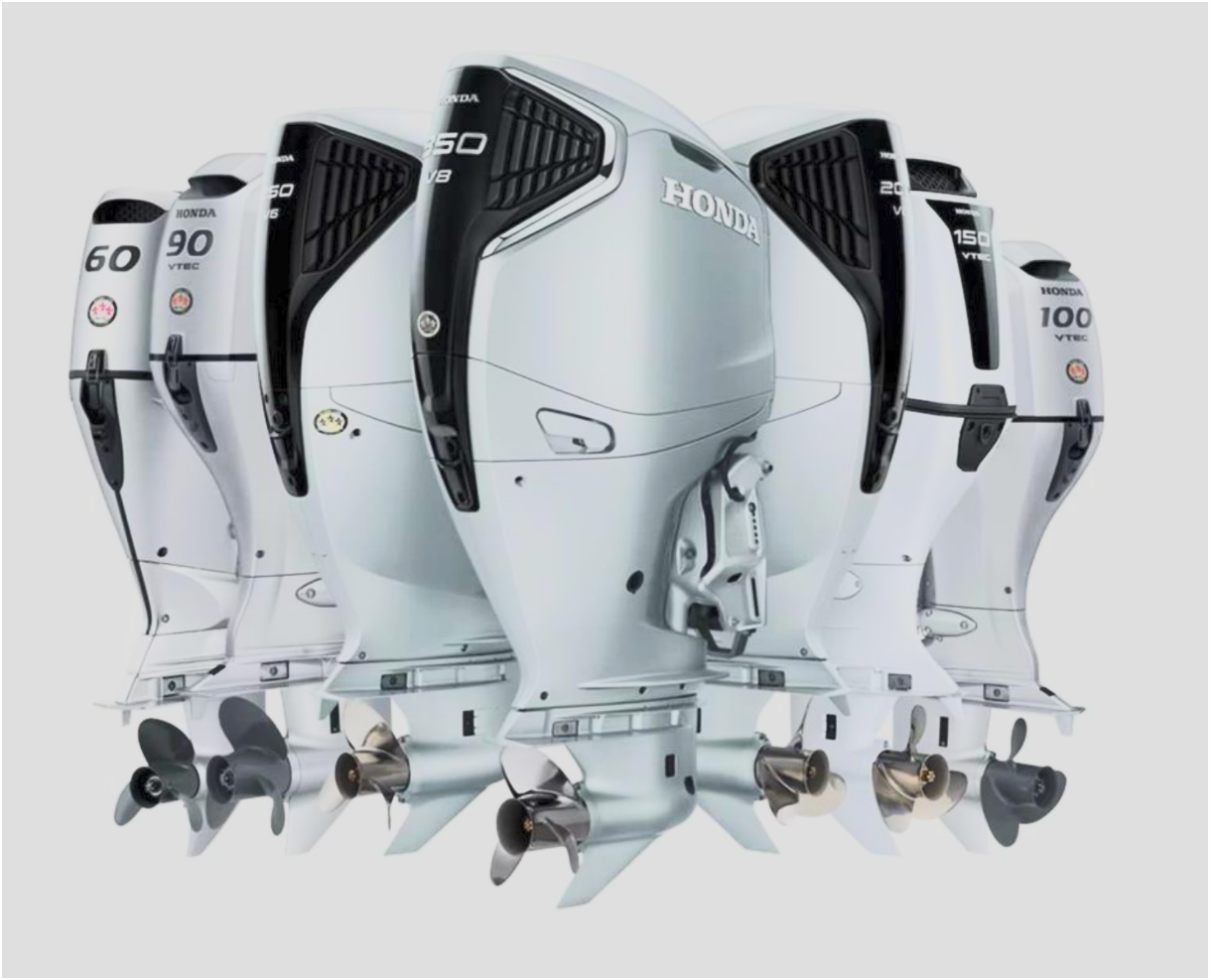
This is worth saying clearly: repowering with Honda doesn’t mean a BF350. Every boat has a maximum horsepower rating, and every boater has a budget. What Honda offers is a complete range: from 2.3 hp portable motors up to a V8 350 hp, so there’s a right Honda outboard for almost any boat.
Honda ranges at a glance
- Portable (2.3 hp – 20 hp)
- Four-stroke reliability in a motor light enough to carry. Brilliant for tinnies, dinghies, inflatables, and tender boats. Clean-starting, fuel-efficient, and completely fuss-free. A world apart from the old two-strokes many boaters in this category are still running.
- Mid-Range (30 hp – 100 hp)
- The sweet spot for most Perth boaties. This is where the majority of recreational boats (the 5 to 6 metre alloy and fibreglass runabouts, the family boats, the estuary fishos) live. Honda’s mid-range is packed with technology: BLAST™ for strong hole-shot performance, ECOmo for fuel efficiency, and VTEC on the BF90 and BF100 for genuine top-end power when you want it. These motors are lightweight for their power output, start on the first attempt, and are built forlong-term reliability.
- High Horsepower (115 hp – 350 hp)
- For larger vessels, offshore rigs, and boats that spend serious time in open water. Beyond the power, the high horsepower range adds features that matter on longer runs: cruise control to hold your speed without constant throttle management, automatic tilt at the touch of a button, and fully digital gauge integration for a modern, clean helm. These engines are built for boats where reliability is essential.


Salt, heat, and the cost of getting it wrong
WA is hard on marine equipment. Salt exposure, summer heat, and boats sitting between weekends all accelerate wear on anything that isn’t built for it.
Honda’s engineering addresses this directly: built-in anodes, corrosion-resistant materials, and design choices that reduce salt traps and make servicing straightforward. Pair that with consistent maintenance habits (flush after saltwater, keep fuel fresh, stick to service intervals), and you have a motor built to last.
Compare that to an older motor that’s been battling salt and heat for years without the same materials or protection. The degradation is in stages until it isn’t. A failure offshore, or even a morning at the ramp that costs you the whole day, becomes more than inconvenience.
The engine hasn’t stopped working, it’s just stopped feeling right. That’s usually the moment people realise it’s time to switch.
The thing that stops a lot of boaters from repowering isn’t making a decision; it’s the logistics. What do you do with the old engine? How do you get it off the boat? Who’s going to give you a fair price without the hassle of selling privately? Your old motor has value. We'll help you put it toward a new one.
Ready to Move On From Your Current Engine?
You don't have to sell your old outboard privately, deal with tyre-kickers, or figure out how to get it off the boat yourself. Portside Marine's Outboard Trade-In program takes care of all of that for you.
Bring in your old motor, we'll give you a fair trade-in value, and you can walk away with a brand-new Honda fitted and ready to go.
Simple as that. You keep the boat you love, just with a motor worthy of it.
Or give us a call on (08) 9335 7233.
We're happy to chat through your options.
